Some students arrive at college with a clear destination in mind. Others arrive with curiosity, a strong interest, and a sense that technology is where the world is heading, even if they are still deciding which door to walk through.
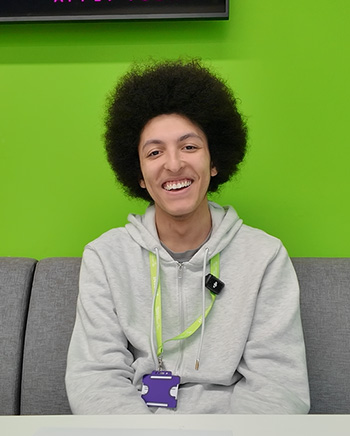
Tajion sits neatly in both camps. He knows he wants a future in the digital industry, but he has also been smart about keeping his options open. That’s one of the reasons he chose the Level 3 T Level in Digital Production, Design and Development at London South Bank Technical College. Equivalent to three A Levels, the Digital T Level is designed with employers, built around real industry skills, and includes a substantial work placement so students can learn in the classroom and prove themselves in professional environments too.
For Tajion, that blend of technical learning and real-world experience has been exactly the point.
Choosing a course that keeps doors open
Tajion originally had his eye on game design. But when it came to choosing a college pathway, he wanted something broader, a course that would still allow him to move into gaming later while keeping other areas of technology open.
By choosing digital software development within the Digital T Level, he’s been able to build a flexible foundation. “It means I still have other parts of tech open to me,” he explains. “If I’d focused only on game design at college, I’d be narrowing things too early.”
That forward-thinking approach reflects the design of the course itself. Students learn the core principles that underpin modern digital systems before specialising further, giving them skills that transfer across roles and industries.
Learning the building blocks of the digital world
On the course, Tajion has been developing practical knowledge across the kinds of technologies that sit behind today’s digital services. This includes working with data types and formats such as CSV, XML and HTML, learning Python, and building confidence in problem solving and algorithms.
Alongside programming, students explore how technology fits into real business contexts and look at emerging areas shaping the digital landscape. Tajion says the course has opened his eyes to just how much there is to learn about technology and how interconnected different areas of the digital industry really are.
Turning learning into content: building a YouTube channel
Alongside his studies, Tajion has also been applying his digital skills independently by running his own YouTube channel, TPS_2009
https://www.youtube.com/@tps_2009
Creating content has given him hands-on experience with scripting, filming, editing, and publishing videos, skills that closely mirror the creative and technical workflows used across the digital sector. Like many people starting out, Tajion found the early stages challenging. Putting yourself on camera can be daunting, especially if confidence doesn’t come naturally.
But consistency made the difference. “Once you start creating regularly, you build confidence,” he explains. “You accept that your first video won’t be perfect, and you improve by doing.”
That mindset aligns closely with software development itself: testing ideas, refining them, and learning through iteration. Managing a YouTube channel has also helped Tajion develop time management skills and a clearer understanding of how digital platforms work behind the scenes.
Industry placement: confidence, resilience and real experience
A defining feature of the T Level is the industry placement, and Tajion’s placement gave him valuable insight into professional digital work.
During his placement, Tajion worked on the concept for a digital platform designed to help college and T Level students connect with work placements. The project involved problem-solving, collaboration, and creative thinking, all within a professional setting.
Tajion also designed the logo for the platform, a moment that stood out for him. It showed him that he could contribute meaningfully to a real project and that his skills were valued by others. Beyond technical ability, the placement helped him build resilience, improve his routine, and gain confidence in a working environment, supported by mentors who encouraged his development.
A positive learning community
Tajion also highlights the importance of the learning environment. On the Digital T Level, students are there because they want to be. That shared motivation creates a supportive atmosphere where people are keen to help one another and stay engaged with the subject.
For technical courses especially, that sense of community can make a huge difference, encouraging students to ask questions, experiment, and learn from mistakes without fear.
Advice for future students
For anyone thinking about applying, Tajion’s advice is practical: build your foundations early. Studying Computer Science at GCSE can make a real difference, even if it’s no longer a formal requirement. And having an interest in technology outside the classroom, whether through coding, content creation, or experimentation, will help students get the most out of the course.
Looking ahead
Tajion hopes to progress to Computer Science at university, using his T Level as a stepping stone into higher-level study and a career in the digital industry. His journey shows how the Digital T Level can support students who are motivated, curious, and willing to learn both inside and outside the classroom.
For students who want a hands-on, employer-informed route into tech, Tajion’s experience demonstrates what’s possible when structured learning meets independent creativity and ambition.